

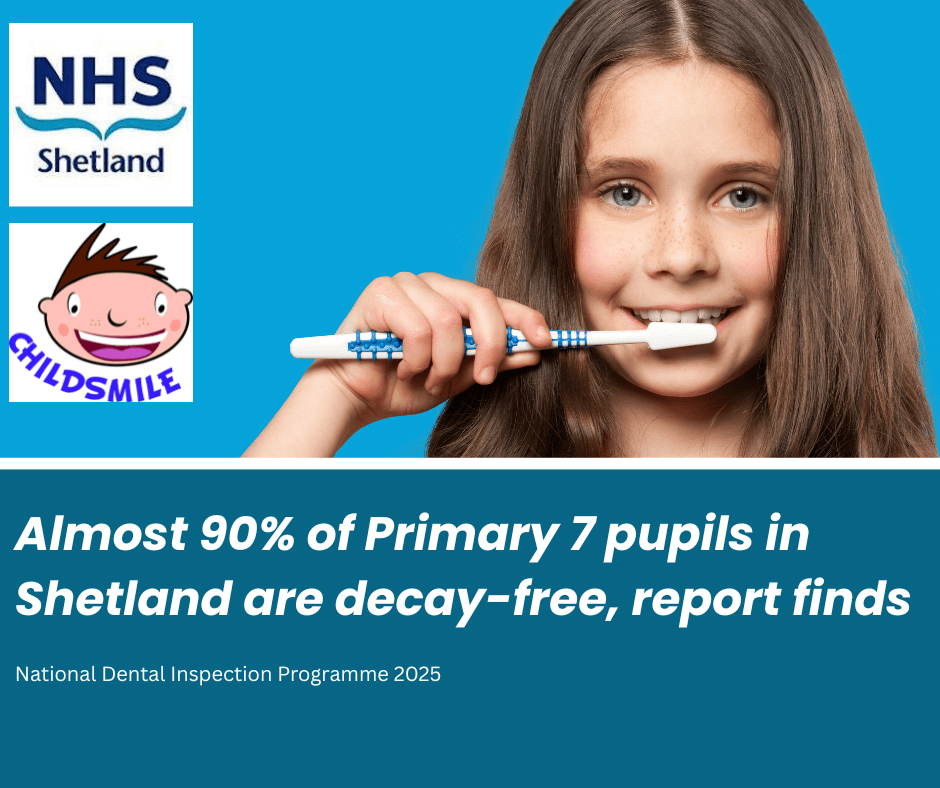
Recent figures from the 2025 National Dental Inspection Programme (NDIP) reveal that 89.4% of Primary 7 pupils in Shetland are decay-free.
The NDIP plays a vital role in:
- Informing parents and guardians about their child’s oral health;
- Monitoring dental health trends among children in Scotland; and
- Assessing the impact of the Childsmile national oral health improvement programme.
This year’s report, published on Tuesday 21 October, focuses on the dental health of Primary 7 pupils in local authority schools across Scotland. Parents and carers receive feedback based on each child’s dental status and any treatment needs identified.
Antony Visocchi, Director of Dentistry for NHS Shetland, said: “These figures are excellent and a huge testament to the dedication of our entire dental team, who continue to work extremely hard in challenging times.
“For our Primary 7 pupils to have 7% less decay than just two years ago, and to also rank second in Scotland for decay-free teeth, is nothing short of remarkable.
“This success provides a strong, disease-free foundation for the future dental health of our young people and means our community will continue to benefit from the ongoing improvements and innovations being introduced within the NHS Shetland Public Dental Service.”
Morag Mouat, Oral Health Improvement Team Leader, said: “We’re absolutely delighted with these results. The fantastic progress we’ve made reflects the strong relationships we’ve built with our partners in the education service here in Shetland. Their ongoing support has been crucial in helping us engage with nurseries, schools and pupils, leading to some of the best participation rates in Scotland.
“To see Shetland achieving the second-highest proportion of decay-free Primary 7 pupils in the country is a real credit to the hard work of the whole dental team involved in children’s oral health, our education partners, and of course the children and families who have embraced the Childsmile programme.”
Key Findings from the 2025 NDIP Report for Scotland
- In 2025, an estimated 81.5% of P7 children in Scotland had no signs of obvious dental decay, similar to the 2023 figure of 81.9%.
- The average number of teeth affected by obvious decay was estimated at 0.40, comparable to 0.36 in 2023.
- Since 2005, obvious decay experience has declined, although this downward trend appears to have plateaued since the COVID-19 pandemic.
- Oral health inequalities remain: in 2025, 71.4% of children living in the most socioeconomically deprived areas had no obvious decay experience, compared to 89.6% in the least deprived areas. Deprivation is measured using Scottish Index of Multiple Deprivation (SIMD).
- The full 2025 National Dental Inspection Programme (NDIP) report is available from Public Health Scotland - https://publichealthscotland.scot/publications/national-dental-inspection-programme/national-dental-inspection-programme-2025/
- Further information on the Childsmile national oral health improvement programme can be found here: Childsmile – Improving the oral health of children in Scotland