

Speech
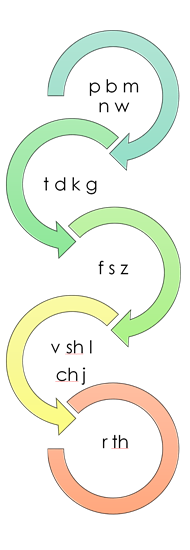
Speech sound development is a complex process that takes time to fully mature. Some sounds develop later than others, so it is normal for children to use certain sounds before others. Generally, for children whose home language is English, speech sounds tend to develop in the following way:
1-2 years
Child will be using vowel sounds and early consonants. They may not use sounds at the ends of words (e.g. 'ho for horse'), or they may use the same sound at the beginning and end of words (e.g. 'gog' for dog). Child may replace quieter sounds with louder ones (e.g. 'big' for pig).
2-3 years
Back sounds 'k' and 'g' may be emerging, but are often produced at the front of the mouth while developing (e.g. 'tar' for car, 'do' for go). Child is likely to miss off parts of longer words (e.g. 'efant' for elephant, 'nana' for banana).
3-4 years
Long sounds are likely to be emerging, but may be replaced by short sounds while developing (e.g. 'dun' for sun, 'beet' for feet). Child's speech will be understood by close family and usually understood by familiar adults outside the home as well.
4-5 years
Consonant blends (e.g. sp, st, bl, etc). will start to emerge but will likely to be reduced to single sounds (e.g. 'poon' for spoon, 'bue' for blue). Likely to be substituting 'w' or 'y' for 'l' and 'r' sounds (e.g. 'yeg' for leg, 'wabbit' for rabbit). By 5 years old, most children will be understood by both familiar and unfamiliar listeners most of the time.
5+ years
The 'r' and 'th' sounds tend to be the last sounds to develop and child may still have difficulties producing these sounds. Often children don't use these sounds until they are at least 6 years old and they may not be in their fully mature form until 7 years old. There will also be different variations of how people produce the 'r' sound.
